You'll be walking through a lane near the ghats, and someone will fall into step beside you. Friendly. Helpful. "You want to see real Banarasi silk? My family's factory, very close, no shop markup, I show you how it's made." Twenty minutes later you're in a showroom, being shown saree after saree, and somehow you end up buying a "pure silk" saree for ₹8,000 that's actually powerloom polyester worth a fraction of that.
This happens to thousands of visitors every year. It's not because you're careless — it's because the whole setup is designed to feel like an authentic, insider experience right up until the moment you pay. So here's how to actually tell a real Banarasi silk saree from a convincing fake, without needing to trust anyone's word for it.
Why This Is So Easy to Get Wrong
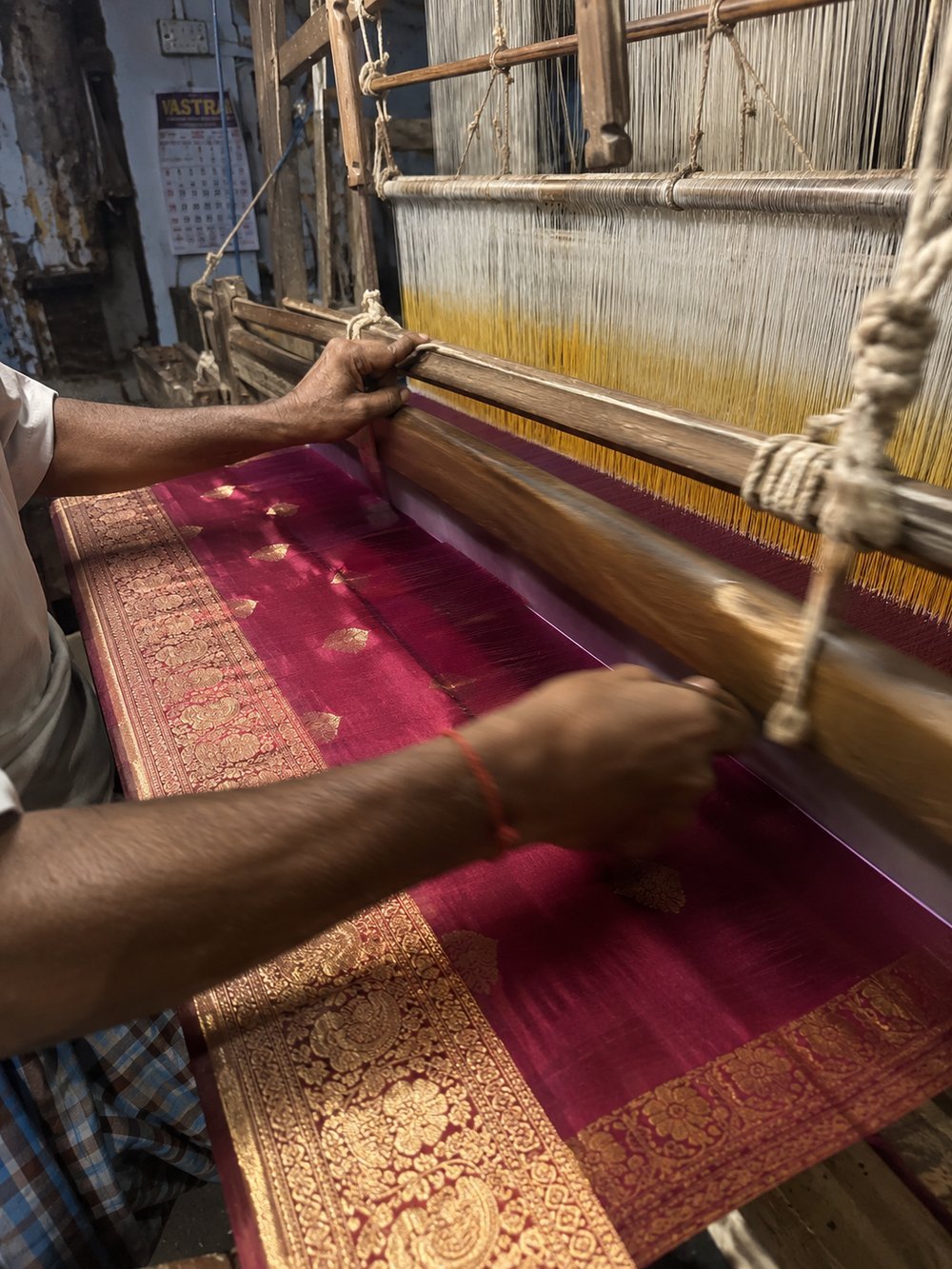
A genuine handwoven Banarasi silk saree can take 15 days to a month to weave, using real silk thread and real zari (the metallic thread in the border and motifs). A powerloom imitation can be made in a few hours, using synthetic thread and machine-printed patterns that look like zari from a distance. Side by side in bad shop lighting, they can look nearly identical. The difference only shows up when you know exactly what to check — which is precisely what a dishonest seller is counting on you not knowing.
The Reverse-Weave Test (Do This First, Every Time)
This is the single most reliable test you can do yourself, in the shop, in under a minute:
- Turn the fabric over and look at the back of the border or motif
- On a genuine handwoven saree, you'll see small floating threads on the reverse side — slightly loose, uneven threads where the weaver has carried the zari across by hand
- On a powerloom or printed fake, the back will look almost identical to the front — too clean, too uniform, because it's machine-printed rather than woven thread by thread
If a seller is reluctant to let you turn the saree over and check the back, that reluctance is itself information.
Check for These Three Things
- The GI tag — Banarasi silk sarees have a Geographical Indication (GI) certification, similar to how Champagne is protected. A genuine tag is a real signal, though counterfeit tags do exist, so treat it as one check among several, not proof on its own
- The Silk Mark label — issued by the Silk Mark Organisation of India, under the Ministry of Textiles' Central Silk Board. This is a numbered, hologram-style label sewn into genuine silk products. Ask specifically for it — a seller who's never heard of it, or brushes off the question, is a red flag
- The invoice HSN code — this is the check almost no tourist knows about, and it's the hardest one to fake. A pure silk product must legally be billed under HSN code 5007. Ask for a proper invoice (not a handwritten chit) and check this code. If the invoice shows a different code, or the seller resists giving a proper GST invoice at all, you are very likely not holding pure silk
What Real Zari Feels and Looks Like
- Real zari has a slightly rough, textured, matte-to-soft-shine finish — it's traditionally made with a silver or gold-coated thread wrapped around silk yarn
- Fake ("tested") zari uses plastic-coated metallic thread — it tends to look uniformly shiny, almost plasticky, and feels smoother and lighter than real zari
- A simple trick: real zari tarnishes slightly over time, the way real silver does. If a seller insists their zari "never tarnishes, ever," that's usually a sign it isn't real zari at all
Fair Price Ranges (So You Know If a "Deal" Is Actually a Trap)
Prices vary widely by design complexity, but as a rough, honest guide:
- Pure silk Banarasi saree, simple border: roughly ₹4,000–8,000
- Pure silk with detailed zari work (Katan, Kadhwa): roughly ₹8,000–20,000+
- Powerloom or semi-silk "Banarasi-style" sarees (which can be perfectly nice to buy — just not for the price of real silk): typically ₹1,500–4,000
If someone offers you a "pure silk, heavily worked" saree for ₹2,500, that price alone is telling you something. Genuine handwoven silk and zari simply cost more to make than that.
The Tout-to-Factory Pipeline (What's Actually Happening)
The friendly stranger who leads you to a "family factory" is very often working on commission from that specific shop — the tour is genuine (many families in Varanasi really do weave at home), but the sales pitch that follows is the business model, not a bonus. This doesn't mean every weaver demo is dishonest — many are wonderful, real, and worth seeing. It means the demo and the sale are two separate things, and you should feel free to watch, ask questions, appreciate the craft — and then check the reverse weave, the label, and the invoice before you decide anything.
The Honest Bottom Line
You don't need to be a textile expert to avoid getting fooled — you just need to know these four checks and be willing to actually use them, even if it feels awkward to flip over a saree in front of a smiling shopkeeper. A seller who's genuinely selling real silk will never mind you checking.
Want an honest recommendation on where to shop, without any commission arrangement on our end? Ask us on WhatsApp — we'll tell you where our own family buys.
Message Us on WhatsApp